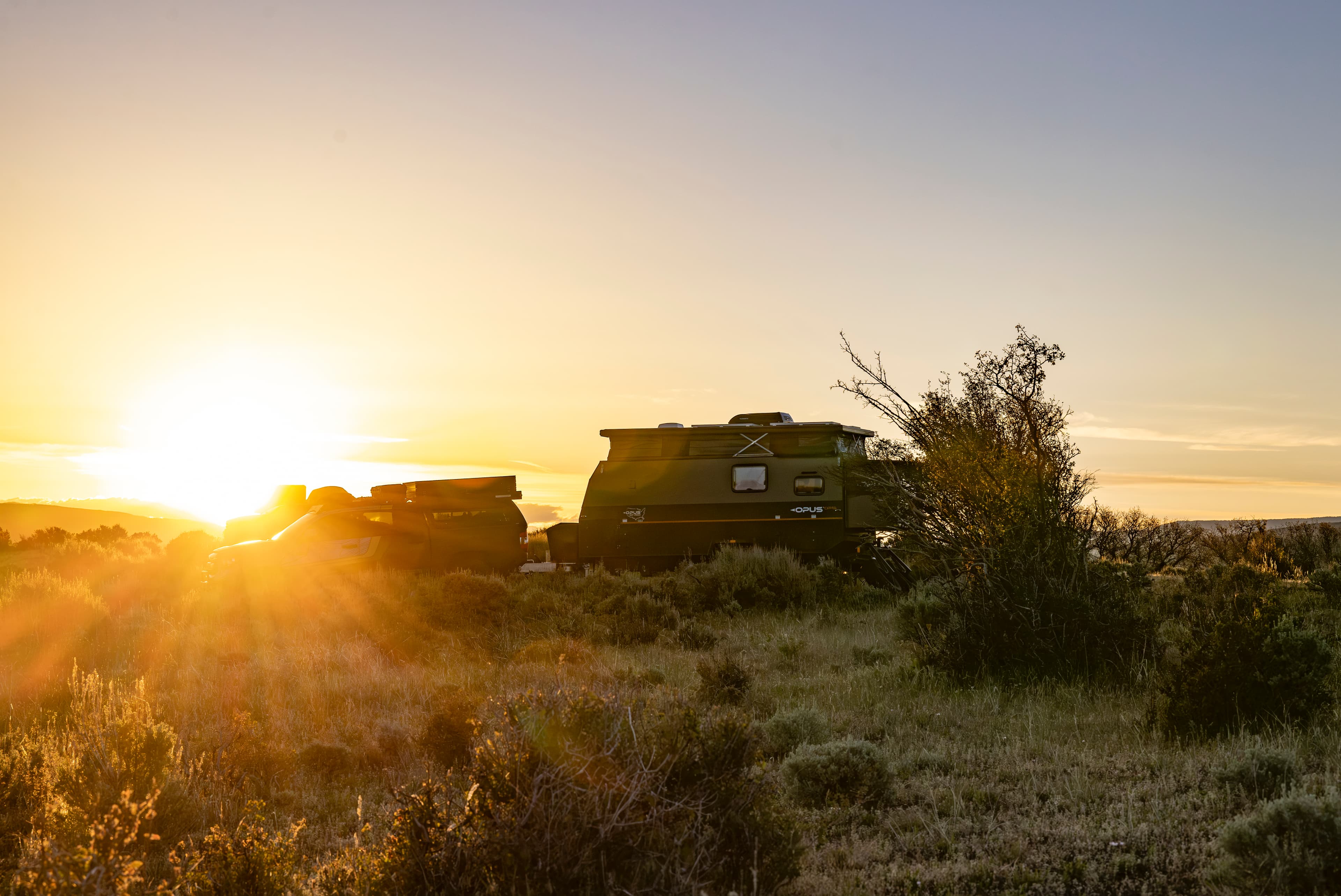
Family off-road camping comes down to one trade-off: the space your family needs versus the weight your vehicle can pull. Every camper on this list resolves it differently.
A hardside trailer with bunks and a full bathroom gives you room to spread out — and asks for 6,000 lbs of towing capacity and a tall profile that catches wind on the highway. A folding camper keeps the towing weight low and the center of gravity down, but setup becomes part of the equation. Somewhere in between sits the camper that actually fits how your family travels.
We've compared ten of the most capable family off-road campers available in 2026 across four things that decide whether a trip is enjoyable or exhausting:
- **Family space** — where everyone sleeps, and whether you can stand up inside
- **Towing ease** — dry weight, tongue weight, and what you need to pull it
- **Ride comfort** — suspension, ground clearance, and how it handles corrugations
- **Setup speed** — how long before the kids are in bed
*A note on specifications: figures below are manufacturer and dealer-listed and vary by model year, trim, and options. Confirm exact weights with the manufacturer before matching a camper to your tow vehicle.*
---
1. OPUS OP15
**Best for: families with kids who need their own beds**
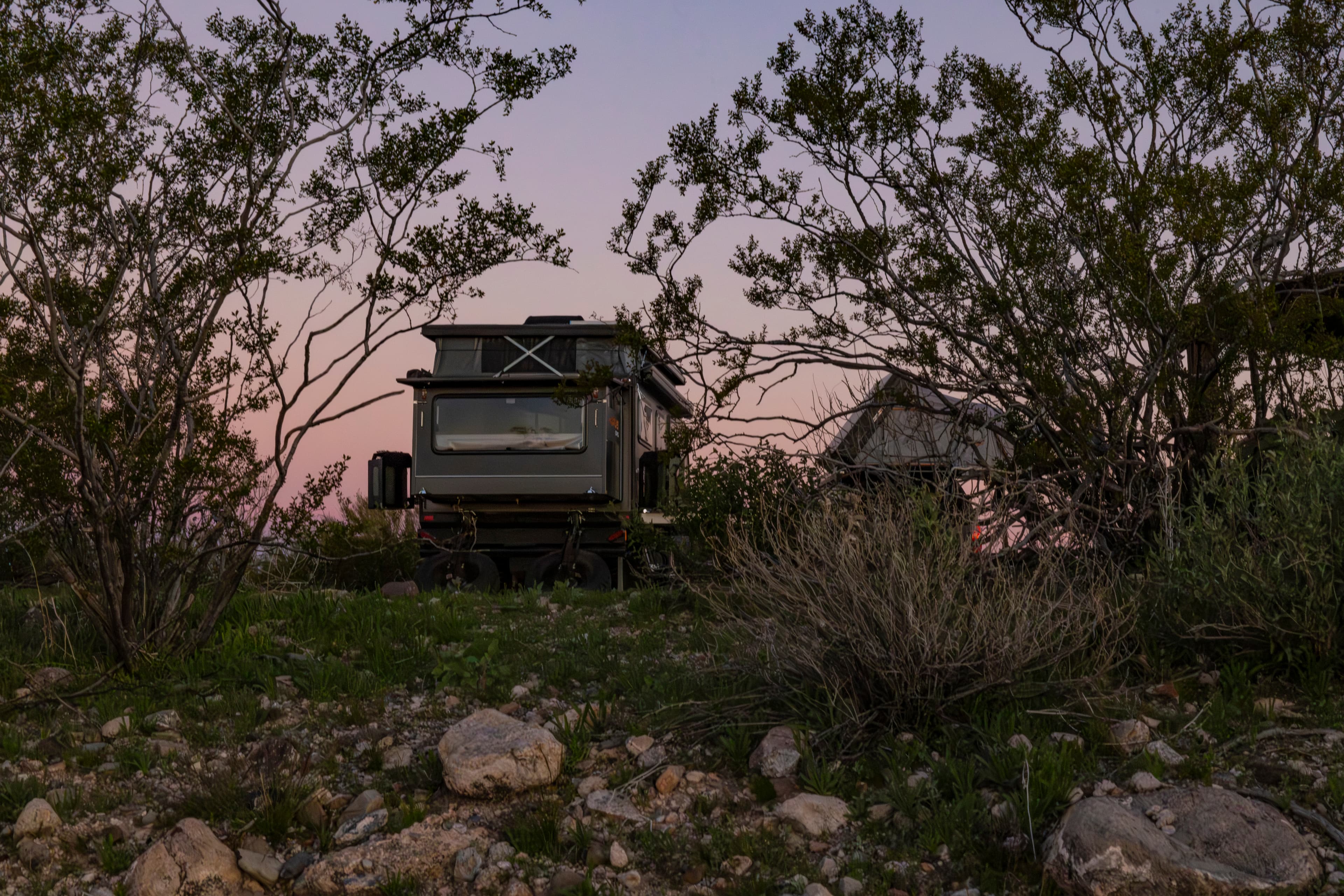
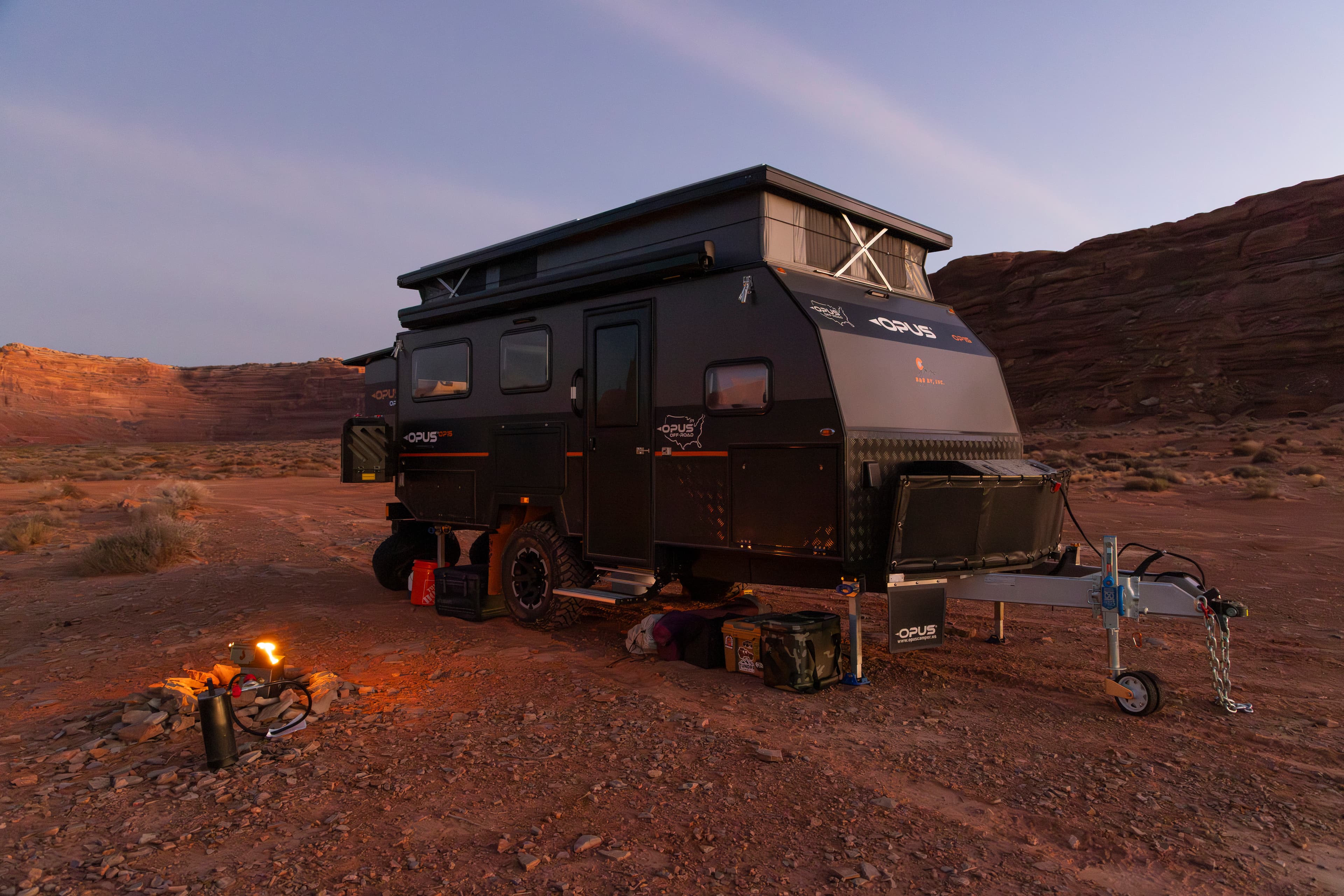
The OP15 is built around the problem most off-road campers ignore — children need somewhere to sleep that isn't a converted dinette. Twin dedicated bunks sit across the full width at the front — each with its own window, fan, and personal lamp. The RV king bed runs at the rear. Kids at one end, parents at the other, everybody with somewhere that is theirs.
The folding design is what makes the weight work. At 5,430 lbs dry, 483 lbs on the tongue and a 6,600 lbs GVWR, a capable half-ton pickup rated to 7,500 lbs tows it comfortably. Because the roof lowers for travel, the OP15 tows with a lower profile and a lower center of gravity rather than catching wind like a full conventional hardside.
Off-grid capability is factory-fitted rather than optioned: 800W of roof solar, a 600Ah lithium battery, and a Victron 2000W inverter and charger. Water is 63 gallons fresh, 17 gray, and 10 black, with heated tanks and insulated lines for cold nights. The full ensuite — interior shower, sink, and flush toilet with Truma Combi hot water — is standard. So is the Dometic rooftop AC.
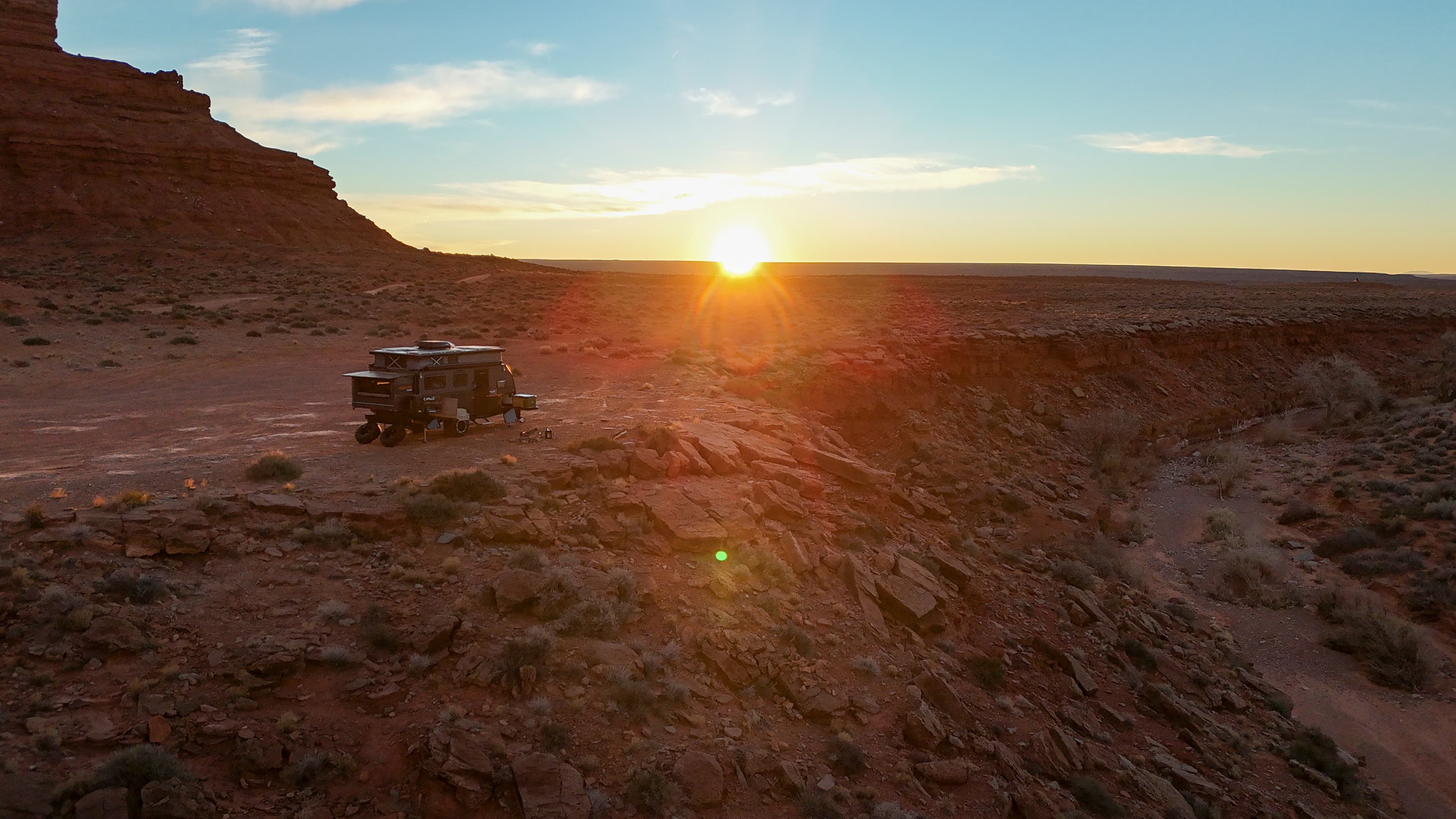
At camp, 13 inches of ground clearance on independent coil-spring suspension and a Cruisemaster DO35 hitch mean the access road in can be rough without punishing the family once you arrive. MSRP is $73,400, fully equipped.
**Family space:** King + twin bunks, sleeps 4, 6'10" interior height · **Towing:** 5,430 lbs dry, 483 lbs tongue — half-ton territory · **Ride:** Independent coil spring, 13" clearance, DO35 hitch · **Setup:** Automatic roof, minutes to level and open
---
2. TAXA Outdoors Mantis
**Best for: families who want hard walls and standing headroom**
The Mantis is a hardside with 94 inches of interior height in its standard configuration — genuine standing room, which matters more than people expect when you're getting kids changed on a wet morning. It sleeps four with the optional folding couch and bunk system, and up to seven with a rooftop tent added.
Dry weight runs roughly 2,972 lbs on earlier models to about 3,486 lbs for the Overland Edition, with a GVWR between 4,200 and 5,000 lbs depending on trim. TAXA suggests a minimum 3,500 lbs towing capacity. Heat and hot water come from a Truma Combi Eco, and a wet bath with cassette toilet and shower is optional — most buyers specify it.
**Family space:** Sleeps 4, standing headroom · **Towing:** ~3,000–3,500 lbs dry · **Ride:** Torsion axle, 11–14" clearance · **Setup:** Hardside, minimal
---
3. inTech Sol Horizon
**Best for: light-filled interiors and simple towing**
The Sol Horizon's panoramic laminated front windshield is the feature people remember, and it does real work on a family trip — a small camper feels considerably less confined when the front wall is glass. Sleeping is a rear queen plus a convertible U-shaped dinette, which handles two adults and two children.
At 19 feet with dry weight listed between roughly 3,543 and 3,900 lbs and a tongue weight near 550 lbs, it sits in comfortable half-ton territory. Construction is a welded aluminum cage frame with wood-free fiberglass and Azdel composite panels. A 15,000 BTU air conditioner and wet bath come standard, with MSRP around $48,341.
**Family space:** Sleeps 4, 78" interior height · **Towing:** ~3,500–3,900 lbs dry · **Ride:** Single axle · **Setup:** Hardside, minimal
---
4. Ember RV Overland Series 221MSL
**Best for: larger families who tow with a three-quarter-ton truck**
If your family has outgrown four berths, the 221MSL sleeps six. Two bunks sit alongside a queen Murphy bed, and Ember's Embertrack system converts the benches into twin bunks, double bunks, a desk, or removes them entirely for cargo space — useful as children get older and needs change.
The cost is weight. At 26 feet 1 inch, 5,850 lbs dry, 715 lbs hitch weight and a 7,550 lbs GVWR, this is a serious tow. The off-grid package is genuinely capable: a Trailblazer heavy-duty off-road chassis, Redarc DC-to-DC charger, and up to 1,200W of solar with a 3,000W Victron inverter on the Max Solar package. A full bath with a 24" x 40" shower and an 18,000 BTU air conditioner round it out.
**Family space:** Sleeps 6, full bath · **Towing:** 5,850 lbs dry — three-quarter-ton territory · **Ride:** Tandem axle off-road chassis · **Setup:** Hardside, minimal
---
5. Black Series HQ12
**Best for: hardside durability in a shorter footprint**
The HQ12 is the compact end of the Black Series range at 19 feet 6 inches, sleeping four with a dry weight around 4,422 lbs, a 7,500 lbs GVWR and 750 lbs hitch weight. That tongue weight is worth noting — it's heavy for the trailer's size and will matter when you load the front storage.
Build quality is the draw. Malaysian honeycomb timber keeps interior weight down, 265/75R16 off-road tires come with two spares, and the electrical system runs a 12V/110V setup with a Black Series pure sine wave inverter. Interior height is 6 feet 7 inches.
**Family space:** Sleeps 4 · **Towing:** 4,422 lbs dry, 750 lbs hitch · **Ride:** Off-road tires, armored underside · **Setup:** Hardside, minimal
---
6. OPUS OP13
**Best for: couples with one or two children who want an ensuite without the OP15's footprint**
The OP13 is 21 feet to the OP15's 23, and at 4,927 lbs dry with 445 lbs on the tongue it comes in 503 lbs lighter and 38 lbs less tongue weight. A half-ton easily handles it, and so does a well-rated mid-size truck or SUV. GVWR sits at 6,600 lbs with 1,673 lbs of payload — the most payload in the hardside OPUS range.
The trade is sleeping: the OP13 has an RV king but no bunks. Built for a couple, for a family of four who need separate beds, the OP15 is the call.
Everything else is the same specification: 800W solar, 600Ah lithium, Victron 2000W inverter, Truma Combi furnace and hot water, Dometic rooftop AC, full ensuite, and the automatic Linak roof. Off-grid range runs four to seven days with the fridge, heating, and everything else running. Two kitchens — a 2-burner inside and a 4-burner slide-out outside — give the cook somewhere to work in any weather. 63 gallons fresh, 17 gray, 10 black, with heated tanks. MSRP starts at $68,400.
**Family space:** Sleeps 2 comfortably (king bed), ensuite · **Towing:** 4,927 lbs dry, 445 lbs tongue — mid-size truck or half-ton · **Ride:** Independent coil spring, DO35 hitch · **Setup:** Automatic roof, same routine as the OP15
---
7. MDC XT12DB
**Best for: bunk-equipped hybrid layout with an outdoor kitchen**
The XT12DB uses a queen bed plus a double bunk, with the lower bunk converting to a dinette and the upper hinging up out of the way — a sensible arrangement when the camper has to be a living space during the day and a bedroom at night.
The underpinnings are built for corrugations: independent trailing arm suspension with coil springs and dual shocks, 12-inch electric off-road drum brakes, a galvanized 150x50x3mm chassis, and a DO35 coupling. The slide-out kitchen keeps cooking smells and mess outside, which families either love or find inconvenient depending on the weather. Specifications differ between Australian and US-market units, so confirm locally.
**Family space:** Sleeps 4, queen plus double bunk · **Towing:** Hybrid weight, confirm by market · **Ride:** Independent coil, dual shock · **Setup:** Hybrid — moderate
---
8. Black Series HQ19
**Best for: couples who want a full bathroom and bring guests occasionally**
The HQ19 is the Black Series flagship and reads as a residential trailer that happens to go off-road — rear bathroom with a full fiberglass shower, front queen bed, a six-cubic-foot refrigerator, and a convertible lounge that provides an additional sleeping space.
Listed sleeping capacity is three on most configurations, so despite the size this isn't the strongest family pick on the list. At 26 feet 3 inches, around 6,122 lbs dry and a 10,000 lbs GVWR, it's also the heaviest here. Two sets of independent suspension and an armored chassis handle the terrain; your tow vehicle needs to handle the weight.
**Family space:** Sleeps 3, full bathroom · **Towing:** 6,122 lbs dry, 10,000 GVWR · **Ride:** Dual independent suspension, armored chassis · **Setup:** Hardside, minimal
---
## 9. TAXA Outdoors Cricket
**Best for: small families prioritizing towing ease above everything**
The Cricket is the lightest hardside on this list by a wide margin — 1,753 lbs dry with a 2,700 lbs GVWR, 15 feet long and 79 inches wide. That makes it towable by vehicles that would be nowhere near rated for anything else here, and it fits in a standard garage.
The trade-off is space. Interior height is 82 inches and the fresh water tank is 15 gallons, so this suits a couple with one young child rather than a family of four on a two-week trip. MSRP runs around $34,500.
**Family space:** Tight — best for 2 adults plus one child · **Towing:** 1,753 lbs dry — tows with almost anything · **Ride:** Torsion axle, 11" clearance · **Setup:** Hardside, minimal
---
10. Bruder EXP-4
**Best for: serious terrain, with family sleeping as an add-on**
The EXP-4 is the most capable chassis on this list. Bruder's patented air suspension levels uneven terrain and counteracts side slopes while moving, and the body cell is engineered to handle ten times its own weight, tested from 122°F down to high-altitude cold.
Base sleeping is two, expanding to around six with a rooftop tent, so families are accommodated rather than designed for. The specification is strong — 400W solar, a 200Ah lithium battery, and 52 gallons of water — and tare weight is listed at about 2,094 lbs with a 4,078 lbs ATM. If your trips are defined by where you can get to rather than how many berths you need, this is the one.
**Family space:** Sleeps 2 + rooftop tent · **Towing:** ~2,094 lbs tare · **Ride:** Patented air suspension — best in class · **Setup:** Quick, rooftop tent adds time
---
The Bottom Line: Matching a Camper to Your Family
Work through these four questions in order and the list narrows quickly.
**1. Where will the children sleep?**
Dedicated bunks (OPUS OP15 Bunk Model, Ember 221MSL, MDC XT12DB) mean beds stay made. Convertible dinettes (inTech Sol Horizon, TAXA Mantis) save space but add a nightly routine. Rooftop tents (Bruder EXP-4) work for older children, less so for a five-year-old at 2am.
**2. What can your vehicle actually pull?**
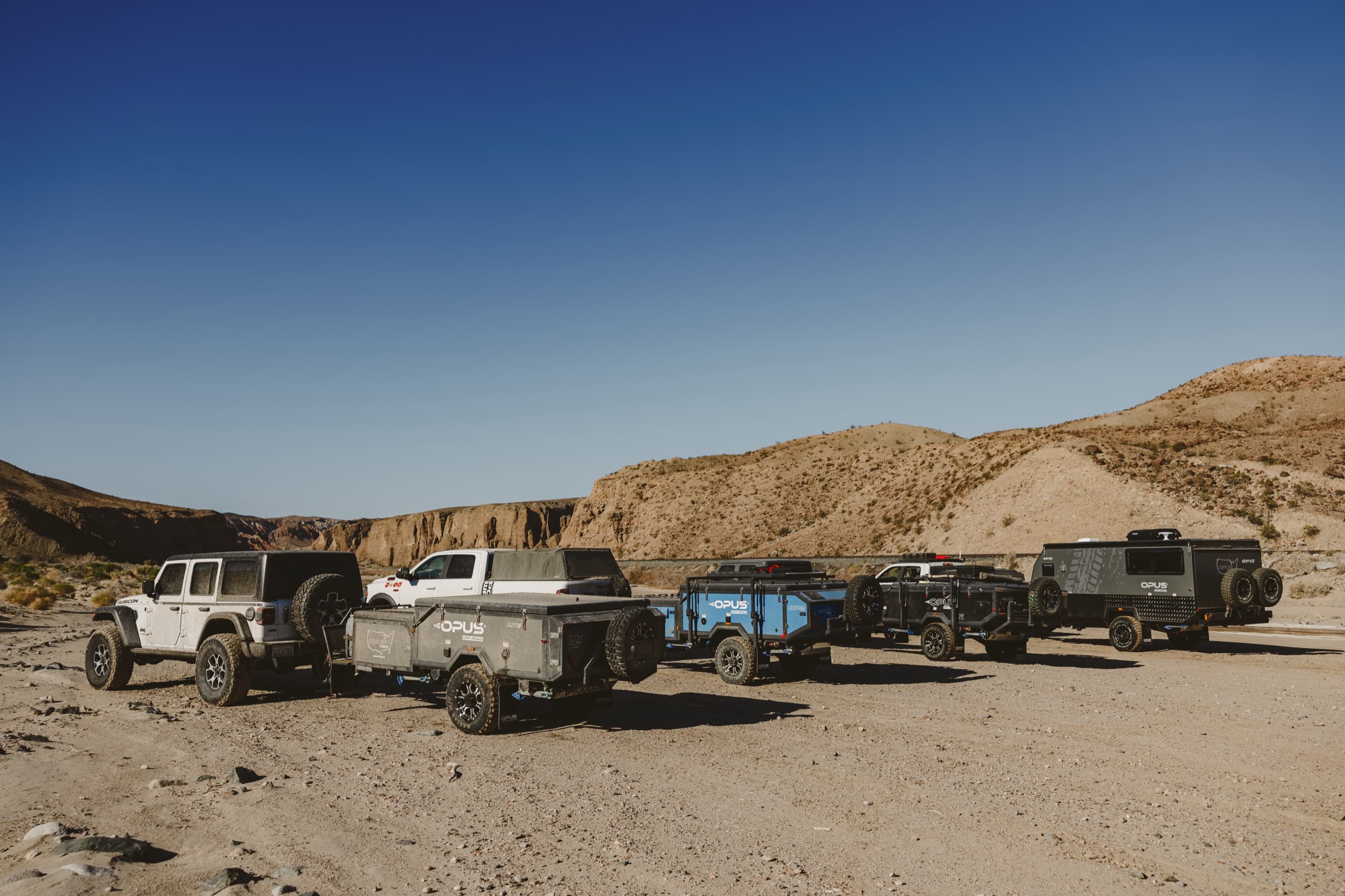
Under 3,000 lbs dry opens up most mid-size SUVs: TAXA Cricket, Bruder EXP-4, and the folding OPUS models. Between 3,000 and 4,500 lbs you need a half-ton or capable mid-size truck. Above 5,000 lbs — Ember 221MSL, Black Series HQ19 — plan on a three-quarter ton.
**3. Do you need an interior bathroom?**
A wet bath or full bathroom adds weight, length, and plumbing to winterize. For weekend trips near facilities, it may not earn its place. For a two-week trip with young children, it usually does.
**4. How much setup can you tolerate after a long drive?**
Hardsides are the fastest — open the door and you're in. Folding campers with air-beam systems take minutes. Traditional pole-frame campers take considerably longer, in whatever weather you've arrived in.
---
Frequently Asked Questions
**What is the best off-road camper trailer for a family of four in 2026?**
For a family of four, the strongest options are those with dedicated sleeping for children rather than convertible furniture. The OPUS OP15 Bunk Model, Ember Overland 221MSL, and MDC XT12DB all provide bunks. The decision usually comes down to towing capacity — The OPUS OP15 has a 5,430 lb dry weight and 483 lbs of tongue weight, which a half-ton pickup rated to 7,500 lbs handles comfortably — the lower entry point by a significant margin. The Ember 221MSL at 5,850 lbs dry needs a larger tow vehicle.
**How much towing capacity do I need for an off-road camper trailer?**
Add roughly 1,000 to 1,500 lbs to the camper's dry weight to account for water, gear, and food, then stay below 80% of your vehicle's rated capacity. A 3,000 lb dry-weight camper realistically needs around 5,000 lbs of towing capacity. Also check tongue weight against your hitch rating — some compact trailers carry surprisingly high tongue weights, such as the Black Series HQ12 at 750 lbs.
**Are folding campers or hardside campers better for families?**
Each wins on different ground. Folding campers tow lighter and lower, which means better fuel economy, less highway sway, and access to trails that taller trailers struggle with. Hardside campers offer instant setup and better insulation in extreme cold. For families towing with a mid-size SUV or who camp on rough access roads, folding campers usually suit better; for cold-weather camping or very frequent short stops, hardsides have the edge.
**How long does it take to set up an off-road camper trailer?**
It varies enormously. Hardside trailers are effectively instant. Folding campers with inflatable air-beam systems — the OPUS range among them — raise in minutes without climbing or assembling poles. Traditional pole-frame camper trailers can take 20 to 45 minutes, which is a meaningful consideration when you arrive after dark with tired children.
**What should families look for in off-road camper suspension?**
Independent suspension with coil springs and dual shocks is the practical baseline for rough roads — it keeps wheels tracking separately over uneven ground and reduces the jarring that shakes interiors apart. Ground clearance of 11 inches or more and load-range E all-terrain tires matter too. Bruder's patented air system is the most sophisticated here, though most families find a well-engineered independent coil setup entirely adequate.
---
Choosing Your Family's Camper
The right camper is the one that matches your family's actual trips, not your most ambitious ones. Most families camp a handful of long weekends and one or two longer trips a year, within a few hours of home, on dirt roads rather than rock crawls. That pattern favors lighter towing weight and faster setup over maximum specification.
The OPUS range is built around that reality — folding campers with real beds for children, air-beam setup measured in minutes, and towing weights that work with the vehicle most families already own.