If you have ever watched a standard camper trailer bottom out on a rutted forest road, you already know the truth: most camper trailers were never built to leave the pavement. They are designed for paved campgrounds with power hookups, level pads, and a short drive from the highway.
The backcountry is a different world. Rough trails, steep approach angles, no hookups, and no cell service demand a trailer engineered for the conditions. This is exactly where folding camper trailers and purpose-built off-road models pull ahead.
Below are the seven most common ways basic camper trailers fall short on backcountry trips — and what to look for instead if you want to camp confidently beyond the trailhead.
1. Ground Clearance That Can't Handle the Trail
Most conventional camper trailers sit low to the ground with minimal clearance. On a smooth road that is fine. On a washboard forest service road or a rocky two-track, low clearance means scraped undercarriages, damaged tanks, and a trailer that gets hung up on the first serious obstacle.
What to look for instead: A true off-road camper trailer rides on a lifted, reinforced chassis with high ground clearance. Independent trailing-arm suspension lets each wheel move over obstacles without transferring the shock to the trailer body — keeping your gear, and your camper, intact.
2. On-Road Suspension That Rattles Everything Loose
Basic trailers typically use simple leaf-spring axles tuned for highway travel. Take that setup down a rough trail and every impact travels straight through the frame. The result is a punishing ride that loosens fasteners, cracks cabinetry, and shortens the life of everything inside.
What to look for instead: Independent off-road suspension with coil springs and dual shock absorbers. This is one of the clearest dividing lines between a campground trailer and a backcountry-capable one. It soaks up trail impacts so your camper arrives in the same condition it left.
3. Standard Couplers That Fight You Off-Camber
A basic ball coupler only articulates a few degrees. The moment your tow vehicle and trailer are on different angles — cresting a hill, crossing a ditch, climbing off-camber terrain — a standard hitch binds up and strains the frame. It also makes hooking up on uneven ground frustrating and slow.
What to look for instead: An articulating off-road hitch such as the Cruisemaster DO35. It allows full independent movement between vehicle and trailer across three axes, so the trailer follows your rig confidently over terrain that would jam a conventional coupler. It also makes hookups far easier, since you can connect from almost any angle.
4. No Way to Stay Off-Grid
The single biggest limitation of a basic camper trailer in the backcountry is power and water. Many rely on shore power for their systems and carry only modest fresh water. Park somewhere without hookups and the lights, fridge, and pump quickly become useless.
What to look for instead: A genuine off-grid power and water package. Look for a lithium battery bank, an onboard charger, a solar input port, and a generous fresh water tank feeding the kitchen. These are the features that let you stay out for days — or weeks — without resupplying or plugging in.
5. Heavy, Bulky Builds That Punish Your Tow Vehicle
Traditional travel trailers are large and heavy, often requiring a full-size truck or a heavy-duty diesel to tow safely. On tight backcountry trails, that bulk becomes a liability — a wide, tall trailer simply won't fit through the wooded, narrow trails common in much of the country, and the extra weight strains a mid-size tow vehicle.
What to look for instead: A lightweight, compact design. Folding and off-road campers are engineered with a smaller footprint and lower dry weight, so they tow comfortably behind a mid-size SUV or light truck and thread through terrain the big rigs can't reach. A lighter trailer also means better fuel economy and more confident braking on descents.
6. Slow, Complicated Setup That Eats Your Weekend
Getting to a remote campsite is only half the battle. Many basic trailers demand a long, fiddly setup process — leveling, connecting, unpacking, and assembling — that can swallow the first hour of daylight at camp. On a short backcountry weekend, that lost time matters.
What to look for instead: A trailer designed for fast deployment. The best folding camper trailers set up in minutes, not hours, with quick-inflating or fold-out tent systems, slide-out kitchens, and storage laid out so everything is within reach. Faster setup means more time enjoying the trip and less time working at camp.
7. Storage That Wasn't Designed for Adventure Gear
Backcountry trips require recovery gear, tools, extra fuel, water, and camp equipment. Basic camper trailers rarely have dedicated, secure, weatherproof storage for these items — so gear ends up crammed inside the tow vehicle or lashed to the roof, exposed to dust and weather.
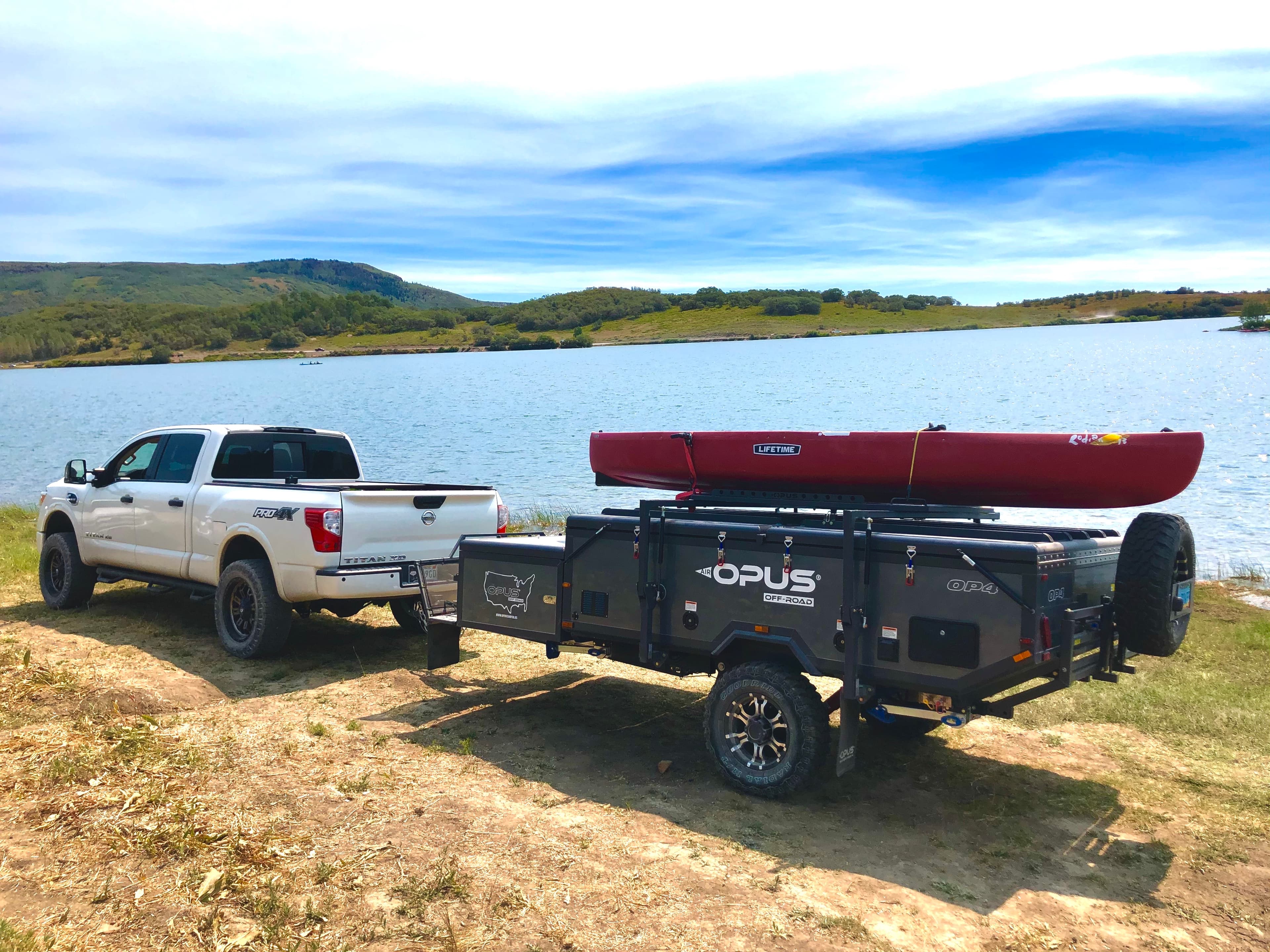
What to look for instead: Thoughtful, purpose-built storage. Look for sealed, lockable exterior compartments, pass-through storage long enough for bulky items, front-tongue storage for propane and fuel cans, and roof or deck space for larger gear like kayaks and coolers. Good storage keeps your cabin clutter-free and your gear protected.
The Bottom Line: Match the Trailer to the Terrain
There is nothing wrong with a basic camper trailer — for the environment it was built for. The problem only appears when you take it somewhere it was never designed to go.
For families and adventure travelers who want to explore beyond the pavement, a folding off-road camper trailer solves all seven limitations at once: better ground clearance, trail-tuned suspension, an articulating hitch, real off-grid power and water, a lightweight and compact build, fast setup, and storage designed for the gear you actually bring.
If your goal is to reach the quiet, remote places most trailers can't — and stay there comfortably — choosing a trailer engineered for the backcountry is the upgrade that makes it possible.
Frequently Asked Questions
What makes a camper trailer "off-road" capable? A true off-road camper trailer combines high ground clearance, independent trailing-arm suspension with shocks, an articulating hitch, rugged tires, and a reinforced chassis. Together these let it travel rough terrain that would damage a standard trailer.
Can you tow a folding camper trailer with an SUV? Yes. One of the main advantages of folding camper trailers is their lightweight, compact design, which allows them to be towed by many mid-size SUVs and light trucks rather than requiring a heavy-duty diesel.
How long can you camp off-grid in an off-road camper? It depends on the power and water setup, but a camper equipped with a lithium battery, solar input, and a large fresh water tank can support several days to a few weeks off-grid, especially when paired with a portable solar panel.
Are folding camper trailers good for families? Yes. Folding camper trailers offer more sleeping space and living comfort than a rooftop or ground tent while remaining light and trail-capable, making them a popular choice for off-road camping families.