When the pavement ends and the adventure begins, your folding camper needs to do more than just tag along. It needs to perform. OPUS Camper builds folding camper trailers designed to handle rough backcountry trails while delivering the comfort you deserve after a long day of exploring.
This guide breaks down the 10 features that separate a capable backcountry folding camper from one that will leave you stranded or frustrated. You will learn what to look for before your next off-grid adventure and why certain features matter more than others when the nearest help is miles away.
Quick guide: 10 folding camper features for backcountry trips
- Rapid AIR tent setup: OPUS Camper's patented technology inflates your tent in under 90 seconds
- Independent trailing arm suspension: Absorbs rough terrain without transferring shocks to your gear
- Articulating hitch system: Allows 360-degree movement for navigating tight switchbacks
- High-capacity solar power: Keeps your batteries charged when you are days from any outlet
- Large freshwater storage: Supports extended stays without water resupply runs
- Slide-out outdoor kitchen: Full cooking capability outside your living space
- Ground clearance and approach angles: Clears obstacles that stop lesser trailers
- All-terrain tires: Grips mud, sand, and rock when you need it most
- Off-grid power management: Lithium batteries paired with inverters for reliable electricity
- Durable construction materials: Weather-resistant fabrics and reinforced frames that handle abuse
How we chose these folding camper features
Backcountry camping demands more from your equipment than a paved campground ever will. We focused on features that directly address the challenges you will face when exploring remote trails, dispersed camping sites, and off-grid destinations across the country.
- Setup speed matters when daylight fades: After hours of driving rough roads, you want camp ready in minutes, not hours of wrestling with poles and canvas
- Suspension protects your investment: Every rock and rut tests your trailer's ability to keep your gear intact and your ride comfortable
- Self-sufficiency extends your range: Solar power, water capacity, and battery storage determine how long you can stay in that perfect spot
- Kitchen functionality affects daily comfort: Preparing meals outdoors with proper equipment turns camping into living, not just surviving
- Durability saves money long-term: Cheap materials fail at the worst moments, while quality construction handles season after season of hard use
- Towing dynamics keep you safe: How your trailer behaves behind your vehicle on uneven terrain directly impacts your confidence and safety
The 10 folding camper features for backcountry trips
1. Rapid AIR tent setup: The best feature for backcountry camping
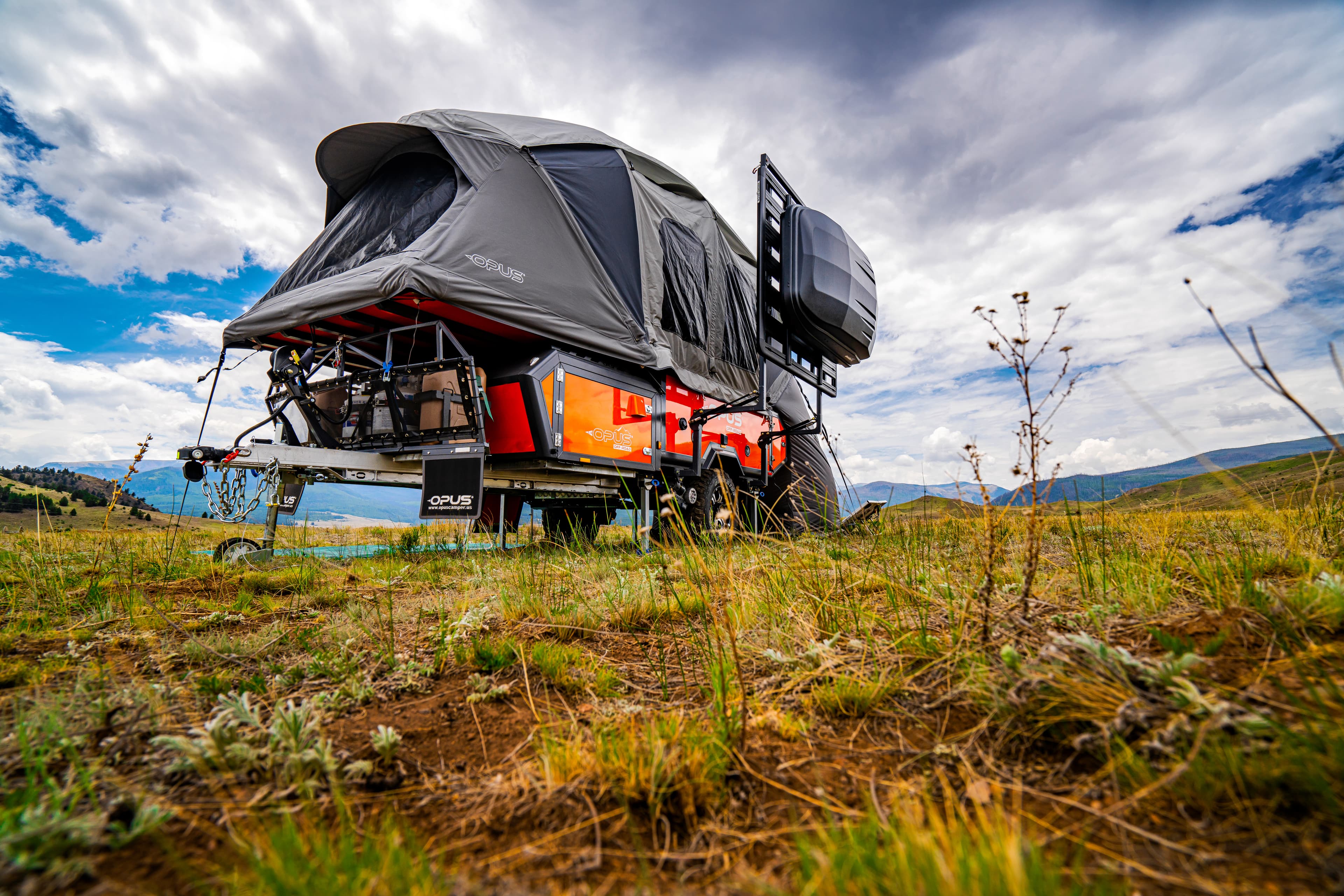
Traditional folding campers require 30 minutes or more of manual assembly with poles, stakes, and frustrating instructions. OPUS Camper changed this entirely with patented AIR tent technology that inflates your complete living space in under 90 seconds using an onboard 12V compressor.
OPUS Camper gives you dual-layer protected AIR beams made from 12oz/420g polycotton that resists water and UV damage. The beams create tall 8-foot ceilings and spacious interiors without any manual frame assembly. When you arrive at a remote campsite after a long day on dusty trails, this feature alone transforms your experience.
The technology works in all weather conditions. High winds, rain, and temperature extremes do not affect the inflation system. Owners report full camp setup in five minutes total, including extending awnings and connecting utilities.
OPUS Camper AIR tent features
- 90-second inflation: The onboard compressor handles the entire process while you prepare your campsite for the evening
- No poles or manual assembly: Eliminates the most frustrating part of traditional camping setup
- Weatherproof construction: Dual-layer waterproof and UV-protected fabric handles harsh backcountry conditions
- Tall interior ceilings: Eight-foot heights let you stand comfortably while changing or moving around inside
- Structural integrity: AIR beams distribute loads evenly across the tent structure for stability in wind
- Optional AIR annex: Adds 70+ square feet of additional enclosed living space using the same inflation system
OPUS Camper AIR tent pros and cons
Pros:
- Fastest setup time available in folding campers today
- Eliminates broken poles and lost tent stakes that plague traditional designs
- Creates more interior volume than pole-based systems of similar weight
Cons:
- Requires functional 12V battery to operate the compressor, though manual inflation is possible as backup
- AIR beam repair kits should be carried for extended remote trips, though punctures are rare with the dual-layer protection
- Learning the optimal inflation sequence takes one or two practice runs at home before your first trip
2. Independent trailing arm suspension: Smooth handling for rough terrain
Standard leaf spring suspensions transmit every bump directly into your trailer. Independent trailing arm suspension with dual shock absorbers isolates each wheel, allowing it to move separately over obstacles.
OPUS Camper trailers feature coil spring suspension with dual shocks on each side. This setup handles deep ruts, rock gardens, and washboard roads without destroying your gear inside. The difference becomes obvious on your first backcountry trip.
Independent suspension features
- Individual wheel travel: Each wheel moves independently over obstacles without affecting the trailer body
- Dual shock absorbers: Dampens rebounds that can cause trailer sway on uneven surfaces
- Coil spring design: Handles heavy loads without sagging over time like leaf springs
Independent suspension pros and cons
Pros:
- Reduces fatigue on long rough roads by smoothing out the ride
- Protects interior contents and appliances from damage
- Improves towing stability at highway speeds
Cons:
- More moving parts than solid axle designs require periodic inspection
- Replacement components cost more than basic leaf spring parts
- Ground clearance depends on spring compression under load
3. Articulating hitch system: Navigate tight trails with confidence
Backcountry roads include sharp turns, steep approaches, and uneven terrain that can damage standard ball hitches. An articulating hitch like the Cruisemaster DO35 allows 360-degree rotation between your tow vehicle and trailer.
This movement prevents binding during tight turns and allows your trailer to remain level even when your vehicle climbs or descends steep grades. The connection stays secure while absorbing the twisting forces that break rigid couplings.
Articulating hitch features
- 360-degree rotation: Full movement in all directions prevents stress on the coupling
- Level towing: Maintains proper trailer attitude regardless of road conditions
- Quick connect system: Easy attachment and detachment at your campsite
Articulating hitch pros and cons
Pros:
- Handles extreme angles that would damage standard hitches
- Reduces wear on both vehicle and trailer frames
- Increases confidence on technical terrain
Cons:
- Higher initial cost than basic ball couplings
- Requires compatible receiver on your tow vehicle
- Periodic lubrication maintains smooth operation
4. High-capacity solar power: Stay charged for days
Running out of battery power cuts your backcountry trip short. Solar panels mounted on your folding camper trailer generate electricity throughout the day, keeping batteries topped off for lights, refrigeration, and device charging.
OPUS Camper hybrid models include up to 600 watts of solar capacity with six 100-watt panels. Combined with lithium batteries that store more usable power than lead-acid alternatives, this setup supports 4-7 days of off-grid camping without generator noise or fuel concerns.
Solar power features
- Roof-mounted panels: Generate power while you camp or drive without any setup required
- Lithium battery storage: Up to 810ah capacity holds days worth of electricity
- MPPT charge controllers: Maximize solar harvest efficiency in varying light conditions
Solar power pros and cons
Pros:
- Silent operation unlike generators
- No fuel costs or resupply requirements
- Automatic charging requires no user intervention
Cons:
- Output drops significantly on cloudy days
- Panels add weight to the roof structure
- Initial investment higher than basic electrical systems
5. Large freshwater storage: Extend your backcountry stay
Water determines how long you can camp in remote areas. Larger tanks mean fewer trips back to civilization for refills. OPUS Camper models hold up to 63 gallons of fresh water, enough for drinking, cooking, and showering over multiple days.
The tanks mount low in the trailer chassis, keeping the center of gravity stable for safe towing. Quick-fill ports and tank level indicators let you manage your supply without guesswork.
Freshwater storage features
- High capacity tanks: Store enough water for extended family camping trips
- Low mounting position: Improves trailer stability when tanks are full
- 12V water pumps: Deliver pressurized water to sinks and showers on demand
Freshwater storage pros and cons
Pros:
- Enables longer trips without resupply
- Supports hot water systems and proper hygiene facilities
- Food-grade tanks keep water fresh and safe
Cons:
- Full tanks add significant weight affecting fuel economy
- Requires winterization in freezing climates
- Tank maintenance needed to prevent algae growth
6. Slide-out outdoor kitchen: Cook outside your living space
Cooking inside a small camping space fills it with heat, smells, and moisture. A slide-out stainless steel kitchen lets you prepare full meals outdoors while keeping your interior clean and comfortable.
OPUS Camper kitchens include 4-burner stoves, sinks with hot water, 12V refrigerators, and prep space that extends from the trailer body. Wind guards protect your flames while cooking.
Outdoor kitchen features
- 4-burner propane stove: Handles multiple pots and pans simultaneously
- Hot water sink: Proper dishwashing and food prep hygiene
- 12V refrigerator: Keeps food cold without ice runs or cooler management
Outdoor kitchen pros and cons
Pros:
- Keeps cooking odors and heat outside your sleeping area
- Larger cooking surface than portable camp stoves
- Integrated design stores securely during travel
Cons:
- Requires propane supply management on extended trips
- Weather exposure during cooking in rain or high wind
- Slide mechanism needs periodic cleaning and lubrication
7. Ground clearance and approach angles: Clear obstacles others cannot
The height between trail obstacles and your trailer's underside determines where you can go. Higher ground clearance and steeper approach angles let you tackle rocky roads, deep ruts, and uneven terrain without scraping or getting stuck.
Folding campers designed for backcountry use position components high and protect vulnerable areas with rock guards and skid plates.
Ground clearance features
- High frame design: Keeps vital components above obstacle height
- Rock guards: Protect front surfaces from thrown debris
- Steep departure angles: Prevents rear-end contact on steep transitions
Ground clearance pros and cons
Pros:
- Access trails that stop other trailers
- Reduces undercarriage damage risk
- Increases confidence on unknown roads
Cons:
- Higher center of gravity requires careful driving
- Entry height may be higher for loading gear
- Some designs sacrifice interior space for clearance
8. All-terrain tires: Grip when you need it most
Standard trailer tires work fine on pavement but lose traction on mud, sand, and loose rock. All-terrain tires with aggressive tread patterns dig into surfaces that would leave highway tires spinning.
Quality off-road tires also resist punctures from sharp rocks and trail debris that frequently damage thinner sidewalls.
All-terrain tire features
- Deep tread patterns: Channel mud and water away from contact surfaces
- Reinforced sidewalls: Resist punctures from rocks and sharp debris
- Wider footprint: Distributes weight for better flotation on soft surfaces
All-terrain tire pros and cons
Pros:
- Confident traction on varied surfaces
- Reduced flat tire risk in remote areas
- Longer service life on rough roads
Cons:
- Increased road noise at highway speeds
- Slightly higher rolling resistance affects fuel economy
- Higher replacement cost than standard tires
9. Off-grid power management: Reliable electricity far from outlets
A complete power system combines solar generation, battery storage, and inverters to deliver household electricity anywhere. OPUS Camper models include 2000-watt Victron inverters that convert 12V battery power to standard AC outlets.
This lets you run small appliances, charge laptops, and power medical equipment without limitations. Battery management systems protect against over-discharge and optimize charging cycles.
Power management features
- Lithium batteries: Lighter weight with more usable capacity than lead-acid
- Pure sine wave inverters: Clean power safe for sensitive electronics
- Battery monitoring: Track state of charge and power consumption in real time
Power management pros and cons
Pros:
- True electrical independence from hookups
- Powers essential devices during extended trips
- Integrated systems work automatically
Cons:
- High-draw appliances deplete batteries quickly
- Battery replacement costs more than basic systems
- Complex systems require learning to operate efficiently
10. Durable construction materials: Built to handle abuse
Backcountry camping puts stress on every component. Aluminum frames, reinforced floors, and weather-resistant fabrics determine whether your trailer survives years of hard use or falls apart after a few trips.
OPUS Camper uses Aluminium Dibond walls, polystyrene insulation, waterproof 10-ply floors, and powder-coated frames designed for longevity in harsh conditions.
Durable construction features
- Powder-coated aluminum frames: Resists corrosion and UV damage
- Waterproof flooring: Prevents rot and mold from moisture intrusion
- Water-tight seals: Finned seal designs block water entry at all joints
Durable construction pros and cons
Pros:
- Longer service life reduces long-term costs
- Maintains value for resale
- Fewer repairs needed over ownership period
Cons:
- Quality materials increase initial purchase price
- Some components may require specialized repair
- Heavier materials affect towing capacity requirements
Comparison table: Folding camper features for backcountry trips
| Feature | OPUS OP4 | OPUS OP LITE | OPUS OP15 Hybrid |
|---|---|---|---|
| AIR Tent Setup Time | Under 2 minutes | 90 seconds | Electric roof (15 seconds) |
| Solar Capacity | Solar port ready | Optional 140W | 600W (6 panels) |
| Freshwater Storage | 40 gallons | 20 gallons | 63 gallons |
| Dry Weight | 3,100 lbs | 2,380 lbs | 5,200 lbs |
| Sleeping Capacity | 4 adults | 2-3 adults | 4 adults |
What features matter most for multi-day backcountry camping trips?
Power and water capacity determine your maximum stay length more than any other factors. If you plan trips lasting 4-7 days between resupply points, prioritize solar panels rated at 400 watts or higher paired with lithium batteries storing at least 200ah.
Water storage of 40+ gallons supports drinking, cooking, and basic hygiene for a family of four over several days. OPUS Camper hybrid models deliver both requirements with integrated systems designed to work together efficiently.
Suspension and hitch quality matter most for comfort and safety. Rough roads amplify small suspension problems into major annoyances over long distances. Independent trailing arm designs with articulating hitches handle conditions that would make basic trailers miserable to tow.
How does rapid tent setup change your backcountry experience?
Arriving at a remote campsite after hours of rough road driving, the last thing you want is another hour of physical labor setting up camp. OPUS Camper's AIR tent technology eliminates this fatigue entirely.
Press a button, wait 90 seconds, and your living space is ready. This leaves energy for the activities that brought you there: hiking, fishing, photography, or simply relaxing in a beautiful location. Families with children appreciate having camp ready before sunset instead of struggling with poles in fading light.
The mental shift matters too. Knowing setup is effortless changes how you plan trips. Shorter stays become practical because breakdown is equally fast. You can explore multiple locations in a single trip instead of committing to one campsite for the duration.
Why OPUS Camper builds the best folding campers for backcountry trips
Every feature on this list exists in the OPUS Camper lineup because the company designs specifically for off-road, off-grid adventures. The patented AIR tent technology alone sets OPUS apart from traditional folding campers that require manual pole assembly.
OPUS Camper gives you independent trailing arm suspension with dual shock absorbers, Cruisemaster DO35 articulating hitches, and all-terrain tires as standard equipment. These are not optional upgrades but core components because backcountry capability requires them.
The combination of rapid setup, robust off-road components, and extended off-grid capacity makes OPUS Camper the top choice for families and adventurers who refuse to stay on paved roads. Join over 40,000 owners already exploring the roads less traveled with confidence.
Explore the complete OPUS Camper lineup to find the right folding camper for your next backcountry adventure.
FAQs about folding camper features for backcountry trips
What makes a folding camper suitable for backcountry camping?
A backcountry-capable folding camper needs independent suspension, high ground clearance, and all-terrain tires to handle rough roads. OPUS Camper builds these features into every model, ensuring you can reach remote destinations without worrying about trail damage.
How long does it take to set up an OPUS Camper?
OPUS Camper's AIR tent technology inflates the complete tent structure in under 90 seconds. Most owners report total camp setup, including awnings and utilities, in about five minutes. This is significantly faster than traditional pole-based folding campers that can take 30 minutes or more.
Can I camp off-grid for multiple days with a folding camper?
Yes, with the right features. OPUS Camper hybrid models include up to 600 watts of solar power, 810ah lithium battery storage, and 63 gallons of fresh water. This combination supports 4-7 days of comfortable off-grid camping for a family without any external hookups or resupply.
What suspension works for off-road folding camper trailers?
Independent trailing arm suspension with coil springs and dual shock absorbers handles rough terrain far better than leaf springs. OPUS Camper uses this design across its lineup, allowing each wheel to move independently over obstacles while keeping your trailer stable and your gear protected.
Do I need special tires for backcountry camping?
All-terrain tires with reinforced sidewalls significantly improve your backcountry capability. They grip better on mud, sand, and loose rock while resisting punctures from sharp trail debris. OPUS Camper models come equipped with appropriate off-road tires for the terrain they are designed to handle.